SponsorsMetrics is the pricing cockpit for YouTube talent agents in France: a benchmark of real CPM by niche, a deal pipeline, an ROI simulator and verified post-campaign reports through the YouTube Analytics API in read-only OAuth. The agent defends a price with external data, not a gut feeling.
01 / 06
Problem
Context
Independent talent agents and most agents inside agencies are paid a percentage of signed deals — 15 to 20%. Every euro won in negotiation is direct income. Yet the price of a YouTube sponsorship is set by feel or by copying another creator, and the brand has no trouble saying “too expensive”.
Problem
What is missing is an external comparable: the real CPM of the French market, by niche, on recent campaigns. Without it, a gaming CPM gets compared to a tech CPM, the discount is negotiated blind and the renewal is justified without evidence.
And what is missing afterwards is proof: a campaign report the brand believes, because it comes from the official API and not from a screenshot.
02 / 06
Constraints
- Read-only OAuth access to the creator’s YouTube Analytics data; encrypted tokens; the sponsor never gets account access.
- A CPM only means something per niche, per period and per guaranteed volume.
- A data product at launch: the benchmark’s value grows with connected campaigns.
- One market, one language: France and French.
What is difficult
The freshness and comparability of a benchmark. A CPM only means something per niche, per period and per guaranteed volume; the pipeline has to hold those dimensions without diluting the distribution with non-comparable campaigns.
Bootstrapping a data product: the benchmark’s value grows with connected campaigns, hence the private beta, the design partners and the free tier.
03 / 06
System
The product as a system
- Campaign data
- Normalisation
- CPM benchmark
- Defensible price
- Verified report
Important product decisions
- One market, one language: France and French. A benchmark is only worth something if it is native to the market where the agent negotiates.
- Free up to three campaigns, no card; a Pro subscription and a multi-user Agency plan with client reporting. The ROI simulator says from how many better-priced deals the subscription pays for itself — and states that it is an estimate, not a commitment.
- Launched as a private beta with design partners rather than open access: a data product needs real data before it has customers.
Screens
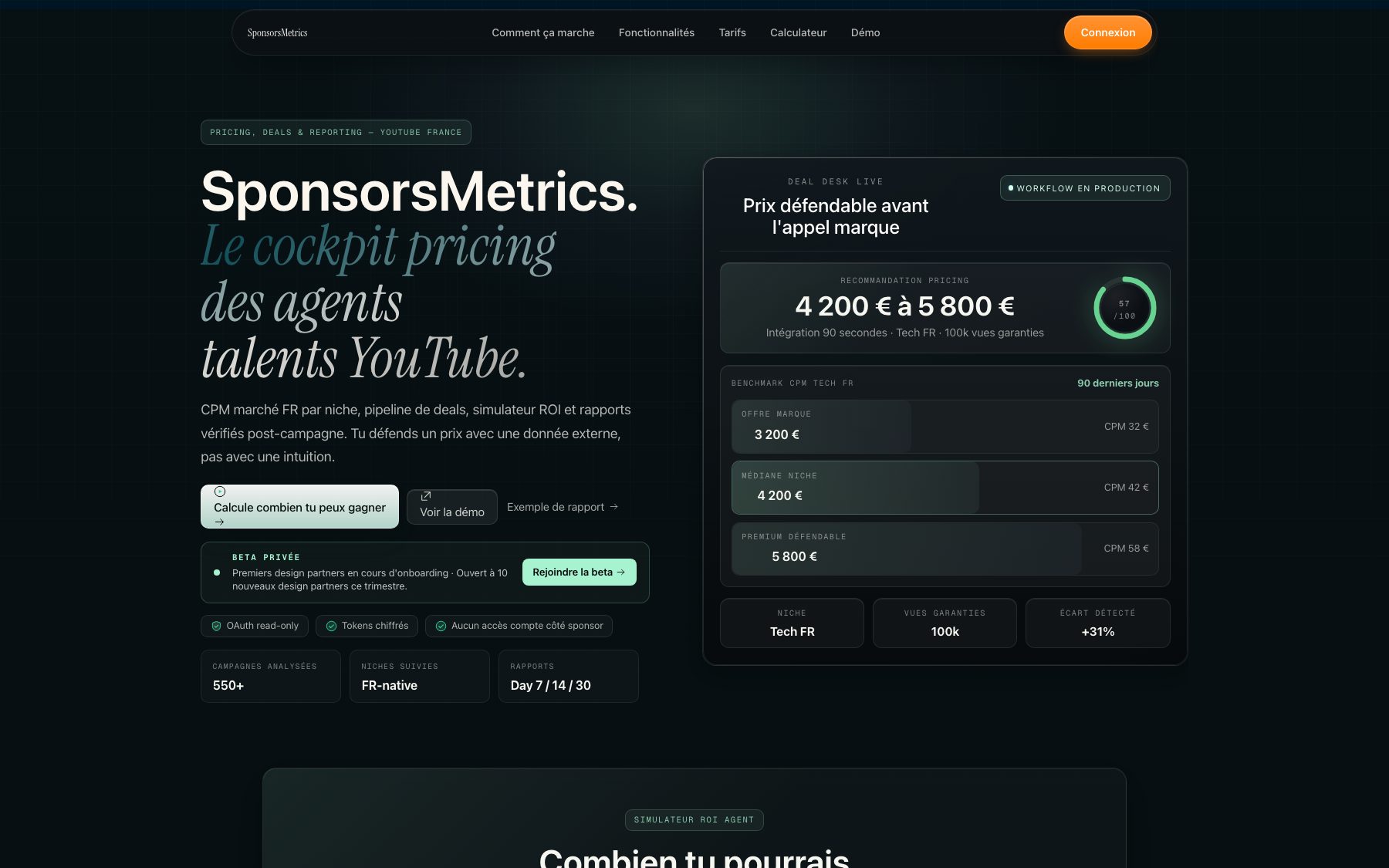
04 / 06
Architecture
From input to fulfillment — every stage, its layer, what happens there.
- YouTube Data APIIntegrations
Collection of public sponsored campaigns, normalised by niche over a rolling 90-day window.
- CPM benchmarkData
Median, P25, P75 per French-market niche — the distribution the pricing engine consumes.
- Price recommendationDomain
A defensible range aligned on niche and guaranteed volume, with the gap against the brand’s offer.
- Deal deskDomain
Deal pipeline, the comparable to bring out in negotiation, the renewal justified.
- YouTube Analytics OAuthIntegrations
Read-only, tokens encrypted at rest, never shared; the sponsor has no account access.
- Verified reportsClient
Day 7 / 14 / 30 from the official API — not from a screenshot; public demo without sign-up.
- SubscriptionIntegrations
Free up to three campaigns, no card; annual Pro; multi-user Agency plan with client reporting.
Product architecture
Three moments of use structure the product. Before the negotiation: the niche’s market CPM — median, P25, P75 — computed on YouTube campaigns analysed through the public API over the last ninety days. During: the comparable to bring out, with a defensible range aligned on niche and volume. After: verified reports at day 7, 14 and 30 from the YouTube Analytics API, sponsored segment isolated, compared to the niche median.
Around it, the deal desk tracks the pipeline and the ROI simulator translates the expected uplift into personal income for the agent. A public demo lets you browse the data as a creator, an agency or a sponsor, without signing up.
Engineering decisions
Access to the creator’s data is read-only OAuth on YouTube Analytics; tokens are encrypted at rest and never shared; the sponsor has no account access. That is what makes the “verified” report credible: it comes from Google, not from a file.
The benchmark rests on a data pipeline from the public YouTube API — collection, normalisation by niche, computation of the distribution — recomputed over a rolling window. The pricing engine consumes that distribution to propose a range.
Next.js, TypeScript, Postgres, YouTube Data and Analytics APIs, Vercel. GDPR compliant.
Domain model
- Campaign
- Sponsored video analysed — niche, period, volume, observed CPM.
- Niche
- The comparability dimension; carries the CPM distribution.
- Deal
- Brand offer, recommended range, pipeline state.
- Channel
- Connected through read-only OAuth; source of the verified reports.
- Report
- Day 7 / 14 / 30, generated from the Analytics API.
05 / 06
Business result
In private beta with design partners: the benchmark, the deal desk and the verified-report pipeline are live, with a public demo and a free tier; open access waits until the data base is large enough — a data product needs real data before it has customers.
Current status
Private beta with design partners; the product is live with a public demo and a free tier. Not yet in open access — a data product needs real data before it has customers.
Business and operating model
Free up to three campaigns, no card; an annual Pro subscription and a multi-user Agency plan with client reporting. The ROI simulator says from how many better-priced deals the subscription pays for itself — and states that it is an estimate, not a commitment.
What shipped
- Built the FR-market CPM benchmark — median, P25, P75 by niche from the public YouTube API
- Shipped verified post-campaign reports from the YouTube Analytics API over OAuth read-only
- Solo across the stack: pricing engine, deal desk, ROI simulator, the data pipeline
06 / 06
Lessons
- 01Proof beats claims: a report pulled from the official API through read-only OAuth is believed where a screenshot is not.
- 02Narrow the market so the data means something: a benchmark is only worth something if it is native to the market where the agent negotiates.
- 03Launch a data product with design partners before open access.
- 04Store distributions, not averages: median, P25 and P75 per niche over a rolling ninety-day window.
What I owned
- Product, design and business model
- YouTube data pipeline — collection, normalisation, distribution
- Pricing engine and ROI simulator
- YouTube Analytics OAuth integration and verified reports
- Deal desk, agency mode and public demo
- Subscriptions and billing
Capabilities proven here
The matching service
- SaaS developer — A complete SaaS product — auth, roles, data, payments, admin, deployment — built for its first real customer.
- Next.js developer — Production Next.js applications — App Router, Server Components, Postgres, Stripe — fast, indexable, maintainable.
- Custom web application — Internal tools, client portals, eligibility engines, back offices — the software that replaces the spreadsheet and the emails.
Related reading
- How much does it cost to build a SaaS v1 in Switzerland?The real price of a first version, without the “it depends” — and why a fixed fee beats hourly billing.SaaS engineering6 minRead →
- Build a SaaS with Next.js, Supabase and StripeThe stack, the order of the steps and the traps — to go from an empty repo to a product that actually charges.Next.js & full-stack7 minRead →
- Next.js architecture for a production SaaS: the decisions I make on every productWhat separates a Next.js project that holds from one that gets rewritten after a year comes down to about ten decisions. Here are mine, as applied on Atamatax, Horvera, Wabiro, SponsorsMetrics — and on this site.Next.js & full-stack9 minRead →
Notes de terrain issues de ce système
Next system
Neucelle