Neucelle replaces a handwritten restaurant cash book with a shared workflow between the restaurant and its fiduciary. Each cash expense carries its receipt and VAT rate; the practice reviews multiple client files from one queue, with access the restaurant can grant or revoke.
01 / 06
Problem
Context
A Swiss restaurant’s cash book is often maintained by hand: receipts pile up, the balance is copied into a spreadsheet, and the fiduciary asks for missing pieces after close. Neucelle connects the restaurant’s work to the practice’s review in one workflow.
The product serves two roles. Restaurant staff record expenses when they happen; the fiduciary receives authorised files in its work queue and prepares them for accounting.
02 / 06
Constraints
- The balance must be explainable from an opening balance and validated movements, without hidden manual correction.
- VAT is decided at the expense level, using the Swiss rates shown in the product.
- A duplicate must be flagged without silently destroying an imported receipt.
- A practice receives only the files a restaurant shares; that permission can be revoked.
- Both sides of the market pay for different workflows but must share the same cash data.
The product constraint
The difficult part is trust in every movement: a balance corrected from memory, VAT estimated at the end, or an overwritten receipt makes an operations tool a new source of discrepancy.
There is a commercial constraint too. The restaurant and the practice each have a paid use; the practice portal is flat-priced so adding clients does not make the product less attractive to the practice.
03 / 06
System
The product as a system
- Cash expense
- Receipt
- Swiss VAT
- Validation
- Fiduciary export
Journey and system
The restaurant records each cash expense, adds a receipt photo, and selects the applicable VAT rate. Validated movements update the balance; missing receipts, discrepancies, and likely duplicates trigger alerts.
The client then grants its fiduciary access to selected files. The practice handles multiple clients from one queue, validates and categorises movements, and hands off the data through CSV or ZIP export.
Screens
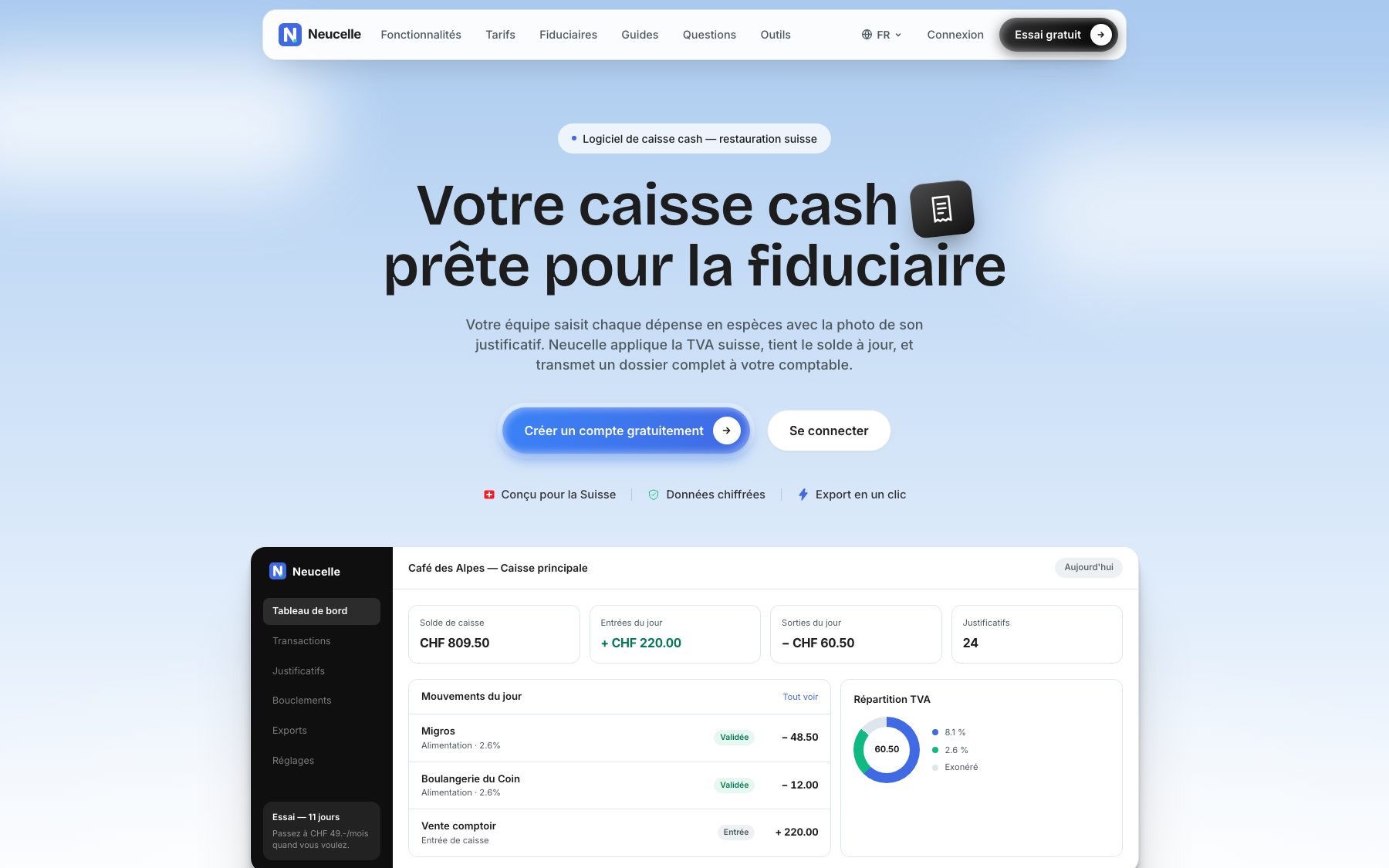
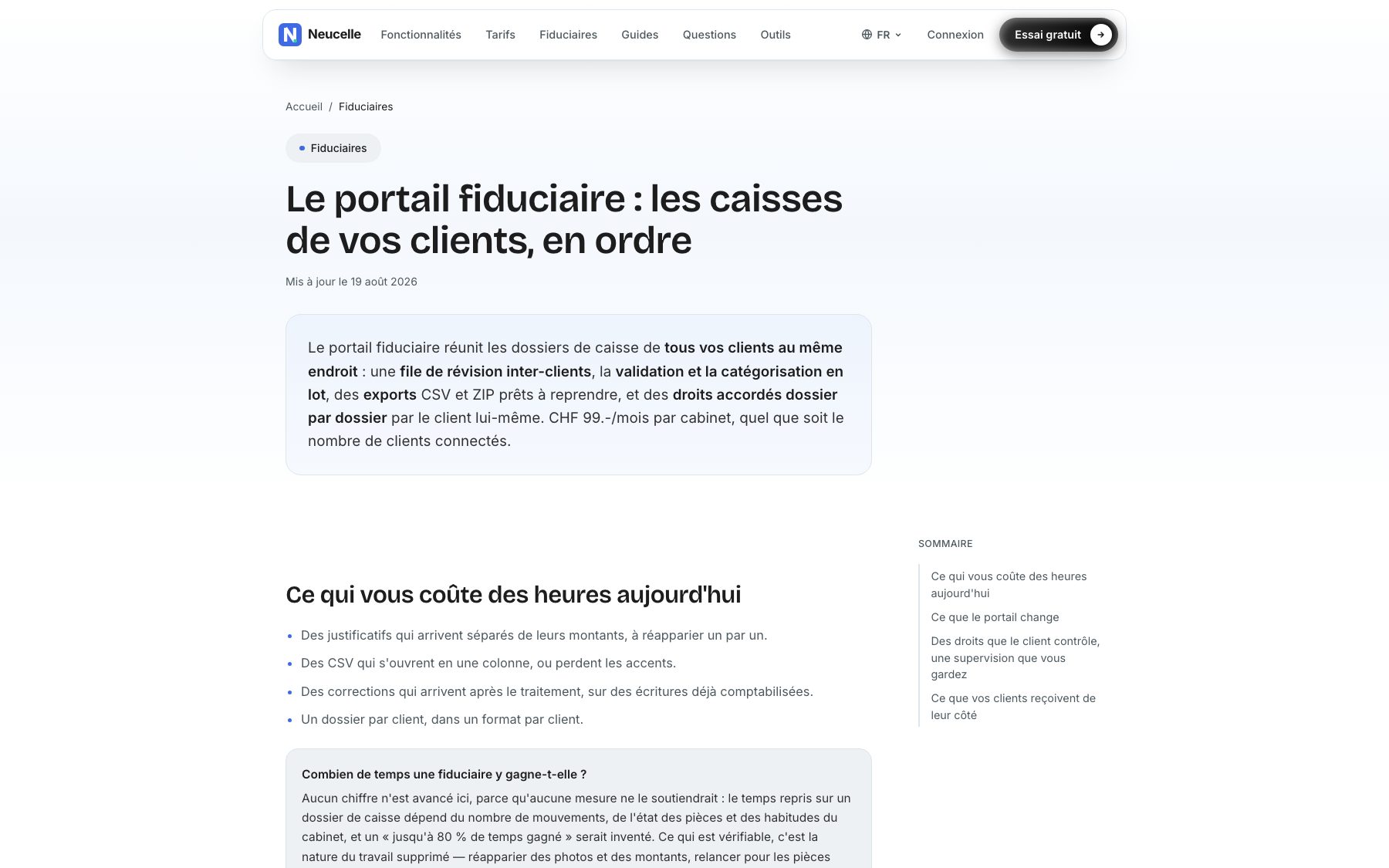
04 / 06
Architecture
From input to fulfillment — every stage, its layer, what happens there.
- Record at the expenseClient
The restaurant logs a cash outflow and photographs its receipt.
- Cash movementDomain
Each validated movement updates the balance from the opening balance; the balance is not retyped.
- VAT per lineDomain
The Swiss VAT rate is attached to the expense when it is entered, instead of being estimated at close.
- ReceiptData
Exact-hash comparison flags a likely duplicate without silently deleting the second import.
- Fiduciary reviewOperations
A cross-client queue lets practices review, validate, and categorise client files.
- Accounting hand-offIntegrations
The practice exports files as CSV and ZIP; access to each file remains under client control.
System architecture
The ledger is reconstructed from the opening balance and validated movements. Each expense keeps its receipt link and VAT rate; exact-hash matching flags an identical import without deleting it. Access is scoped per file so practice access depends on the restaurant sharing it.
Restaurant subscriptions and the fiduciary portal reflect two distinct jobs. The portal charges a flat practice fee rather than a per-file amount; the documented features include cross-client review, batch validation, and CSV/ZIP export.
Product and engineering decisions
The balance is not an editable field of record: it follows from the movements. Identical receipt detection produces a signal instead of an automatic deletion. And file sharing is controlled by the client, with revocation available.
These decisions favour a verifiable record and understandable permissions over irreversible automation. Published rates and product journeys are available in FR, DE, and IT.
Domain model
- Cash movement
- A validated inflow or outflow that contributes to the computed balance.
- Receipt
- A document linked to a movement; identical imports are flagged by hash.
- VAT rate
- A rate applied to each expense line.
- Client file
- A workspace the restaurant shares with its fiduciary and can revoke.
- Fiduciary review
- A cross-client queue with batch validation and export.
05 / 06
Business result
A workflow split across a drawer, memory, and spreadsheet becomes a cash ledger with receipts, VAT, fiduciary review, and export. Neucelle publishes separate offers for restaurants and practices in French, German, and Italian.
Current status
In production with subscriptions live. Published prices are CHF 49/month per restaurant and CHF 99/month per fiduciary practice; 14-day trial, no card.
Business and operating model
The restaurant pays to organise its cash operations; the fiduciary pays a flat fee for its portal, regardless of the number of client files. The flat fee avoids penalising a practice for connecting more clients.
What shipped
- A cash balance recomputed from the opening and every validated movement — never typed by hand, never corrected from memory
- Receipt capture with exact-hash duplicate detection: the second import is flagged, never silently deleted
- Swiss VAT applied per line (8.1%, 2.6%, exempt) at the moment of the expense instead of estimated at the year-end close
- A fiduciary portal with a cross-client review queue, batch validation and categorisation, CSV/ZIP exports, and per-file rights the client controls
- Alerts that fire on the day — cash discrepancy, missing receipt, probable duplicate — instead of at month end
- Shipped in the three languages the Swiss HORECA market actually works in (FR, DE, IT)
Distribution model
The pricing page serves two buyers: CHF 49 per month for a restaurant and CHF 99 per month for a fiduciary practice, each with a 14-day trial and no card. The practice can start by inviting or connecting clients already using the product; its price does not rise with the number of files.
06 / 06
Lessons
- 01Computing the balance from movements makes every discrepancy traceable; asking teams to retype it recreates the original problem.
- 02Detecting a duplicate is not the same as deciding to delete it: preserve the signal and let a person verify it.
- 03Per-file access lets a restaurant share accounting work precisely without opening its whole organisation.
- 04A flat practice price aligns portal revenue with connecting more files instead of charging a penalty per client.
What I owned
- Cash ledger and movement model
- Swiss VAT applied per expense
- Receipt capture and duplicate detection
- Fiduciary portal and per-file access
- Separate restaurant and practice pricing
- Trilingual product: FR · DE · IT
Capabilities proven here
The matching service
Related reading
- Prototype or v1: the difference that decides your launchA prototype impresses in a demo. A v1 survives the first real customer. Confusing them is expensive.Building products5 minRead →
- How much does it cost to build a SaaS v1 in Switzerland?The real price of a first version, without the “it depends” — and why a fixed fee beats hourly billing.SaaS engineering6 minRead →
Next system
ComptaNexo